

Article
Christian-Géraud Neema
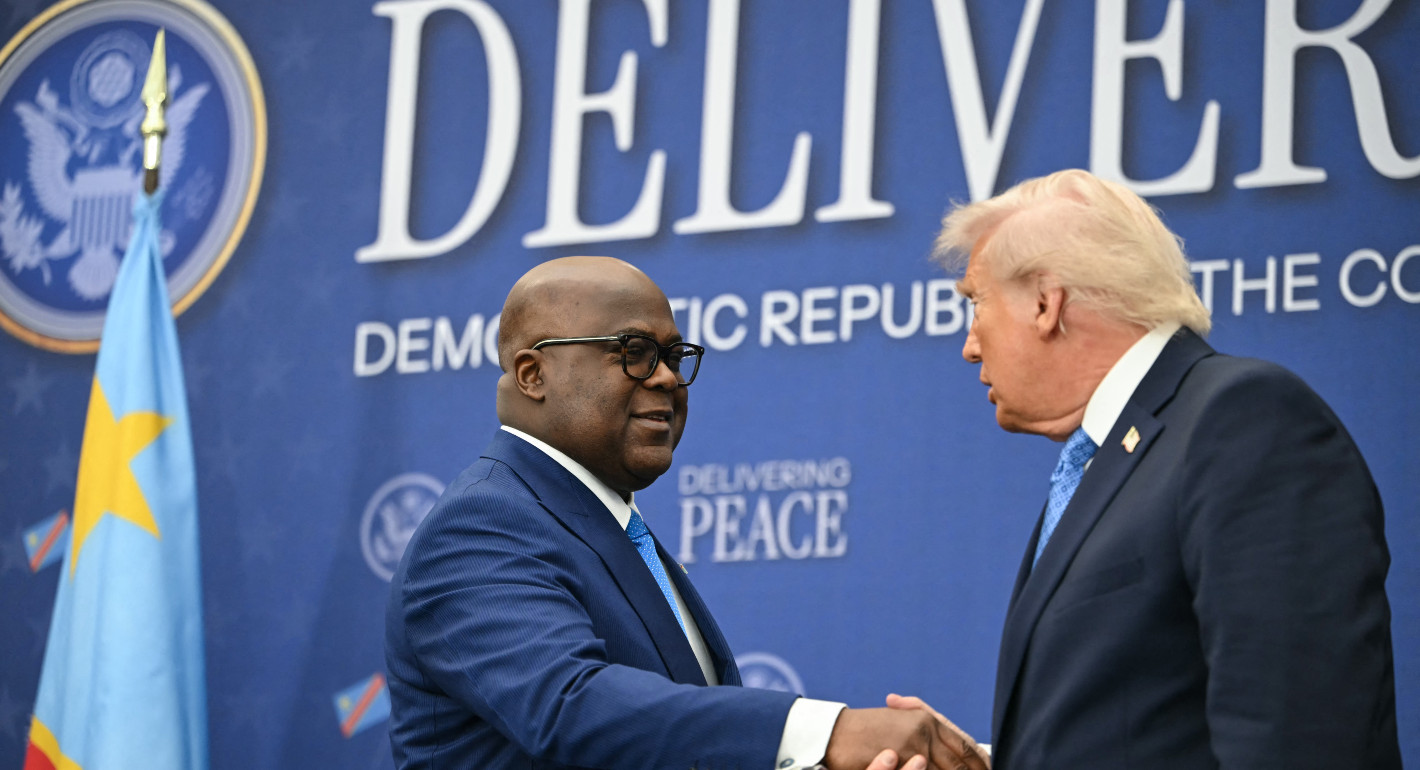
Source: Getty
President Tshisekedi is implicating Washington in his pursuit of a third term. Staying silent may prove detrimental to the United States in the long run.
The Democratic Republic of the Congo’s (DRC) next general election is scheduled to take place in December 2028. The ruling coalition in the DRC, Union Sacrée de la Nation, has expressed its ambition to amend or rewrite the Constitution to grant President Félix Tshisekedi a third term—which he would willingly accept. Tshisekedi has cited the U.S.-DRC Strategic Partnership Agreement (SPA) as one justification for this constitutional amendment, arguing that the change is required by the SPA, even as civil society and the political opposition have contested the amendment.
For the DRC, the stakes are high. The 2028 election would represent the country’s first succession between two presidents who would both have come to power through the ballot. Moreover, any attempt at derailing this process could trigger widespread violence and protests across the DRC, further imperiling the fragile Washington Accords for Peace and Prosperity.
During a press conference held in Kinshasa on May 6, 2026, Tshisekedi presented the constitutional amendment as one of the conditions allegedly required by Washington as part of the bilateral strategic partnership signed between the two countries in December 2025—a claim for which he did not offer evidence. This argument is now being echoed by the ruling coalition in support of Tshisekedi’s political agenda.
In invoking the U.S.-DRC SPA, the Congolese president and the ruling coalition are referring to Article XII of the agreement—“Fiscal, Tax, and Regulatory Framework”—in which the Congolese authorities commit to taking all necessary measures to guarantee successful implementation, including constitutional amendments, within twelve months after the signing of the agreement. In Paragraph 2(a) of that article, the DRC commits to amending “Law No. 13/005 of 11 February 2014 on the fiscal, customs, parafiscal, non-tax revenue and exchange regime applicable to collaboration agreements and cooperation projects and to undertake any legislative and constitutional reforms . . . to align its legal framework” with the SPA. The agreement does not specify the nature and purpose of any needed constitutional changes.
By instrumentalizing the SPA, Tshisekedi is drawing Washington into the country’s domestic political debate and making it a de facto accomplice to his political ambitions.
The ambiguity created by the DRC’s vague commitment to constitutional change opens the door to interpretations that can be used to further any political agenda. The provisions mentioned in Paragraph 2(a) of the SPA’s Article XII do not require any constitutional changes. To align with the SPA, the DRC would have to refine its fiscal law and its mining code, but not its constitution.
The United States has not substantiated or responded to Tshisekedi’s claims.
It therefore appears that the Congolese government is using this agreement as a pretext to advance its own political agenda, portraying the success of the SPA as the ultimate objective the country must achieve. By instrumentalizing the SPA, Tshisekedi is drawing Washington into the country’s domestic political debate and making it a de facto accomplice to his political ambitions—with potentially dire consequences for the DRC’s stability. This perilous constitutional change should matter to Washington, since it could potentially undermine the United States’ medium- and long-term strategic commercial interests. By remaining silent about Tshisekedi’s instrumentalization of the SPA, the administration is also jeopardizing two of its own foreign policy objectives in the DRC: obtaining critical minerals and countering Beijing.
Meeting Washington’s expectations—access to critical minerals—is perceived in Kinshasa as the foreign policy objective that will secure support from U.S. President Donald Trump’s administration for the DRC against its enemies. In this context, Washington’s silence regarding Tshisekedi’s ambitions could easily be interpreted as tacit support for the regime; it allows the United States access to critical minerals despite the dangerous long-term consequences such support could have for the DRC’s political stability. From a geopolitical standpoint, even silently supporting a regime that has proven to be U.S.-leaning and ready to prioritize U.S. companies’ interests over those of the United States’ main competitor, China, may be appealing—yet carries far greater risk to long-term U.S. interests in the DRC.
If left unaddressed, the apparent quid pro quo sustaining the SPA—access to critical minerals in exchange for political support—will trigger a political crisis in the DRC. In the context of the war in the eastern DRC, that crisis would likely spiral into an even larger and more complex one.
Such a crisis would elevate the country’s risk profile, deterring U.S. companies from investing in the DRC. Historically, the DRC’s political instability has been a major hindrance to investment by U.S. companies. A 1982 report on cobalt policy by the U.S. Congressional Budget Office clearly emphasized that political instability in Zaire (now the DRC) had threatened the U.S. cobalt supply chain and hindered investments.
Washington’s silence regarding Tshisekedi’s ambitions could easily be interpreted as tacit support for the regime.
When the Trump administration allows the SPA to be manipulated in a way that could exacerbate the Congolese political crisis, it is working against the SPA’s own objectives. Meanwhile, for companies from some third countries with a much higher risk appetite than American companies, a high-risk environment will present an opportunity by eliminating potential U.S. corporate competition.
It may be argued that the Trump administration’s silence stems from its new policy of not commenting on foreign elections and, by extension, anything related to them—such as constitutional or electoral regulatory changes.
But will that non-interference hold in the context of geopolitical competition with China over critical minerals in a country where China has historically held an advantage that this administration is actively trying to counter? Will Washington remain silent or indifferent if political changes in the DRC lead to an openly pro-China, anti-U.S. actor in power who may alter the current dynamic created by the U.S.-leaning Tshisekedi? As the United States openly attempts to counter China in the DRC, the realpolitik is that Washington has a stake in who leads the DRC.
Even if the Trump administration’s silence on this matter is framed as a new non-interference policy, it is also undeniably rooted in a geopolitical calculation that hinges on who holds power in the DRC.1 The presence of a China-leaning president—or one perceived as such, like former president Joseph Kabila—would certainly not leave Washington indifferent, given the current geopolitical context. So, silence itself becomes a form of engagement in the DRC’s politics that the United States is unlikely to acknowledge.
The proposed constitutional change also threatens to undermine the U.S. administration’s narrative of Trump as a peacemaker in the DRC and contradicts the administration’s past and present positions on this issue, weakening the coherence of Washington’s message in Africa. Layering a political crisis over a security crisis that the administration and other actors have been trying to solve through the Washington Accords of December 2025, the African Union initiatives, and the Doha process is likely to defeat all the diplomatic efforts for peace the administration has been putting into the DRC.
Furthermore, Washington’s silence directly contradicts past and current policy from the United States and Trump himself on constitutional change in the DRC.
From 2014 to 2018—a very different era of U.S. engagement in the DRC, spanning from the Barack Obama administration to Trump’s first presidency—Washington pressured Kabila, whom Washington suspected of seeking to amend the constitution in order to remain in power, to refrain from seeking a third term. John Kerry, secretary of state in 2014, along with successive U.S. special envoys for the African Great Lakes region Russ Feingold and Tom Perriello and members of the U.S. House of Representatives and Senate on both sides of the aisle, repeatedly reminded Congolese authorities of the U.S. position on the issue and its commitment to seeing a democratic transition take place.
Subsequently, during a 2017 visit to Kinshasa, Nikki Haley, then U.S. ambassador to the United Nations, clearly expressed the first Trump administration’s opposition to any attempt at constitutional revision and further election delays. At a hearing before the House Foreign Affairs Committee Subcommittee on Africa, Global Health, Global Human Rights, and International Organizations in November 2017, the acting assistant secretary at the Bureau of African Affairs in the State Department, Donald Yamamoto, said Haley’s trip had sent “a clear message to President Kabila and his government that further delays and an unrealistic electoral calendar would be unacceptable. Ambassador Haley also told opposition party leaders that the United States does not support calls for unconstitutional change and stressed the need for all actors to work within the framework of the DRC constitution.”
Unlike Kabila’s regime, Tshisekedi’s has openly expressed its intention to amend the Constitution and remain in power for a third term.
It may be argued that the Trump administrations of 2017 and of 2026 are not the same. They operate under different contexts, with different expectations and the latter with a far more transactional mode of engagement, and there may be no reason to expect the latter to act on the reflexes of the former.
Unless this administration deems that the constitutional changes sought by Tshisekedi will bring stability, staying silent would contradict Washington’s own stance.
However, the point is not to hold this administration to U.S. foreign policy precedent. This U.S. administration, of its own accord, made the question of electoral manipulation part of its stance on the DRC when it sanctioned Kabila on April 30, 2026. It chose to invoke his past election delays—a grievance dating back nearly a decade—even though his alleged ties to the M23 alone would have explained the designation.
By reaching back for that argument, Washington made its own position on constitutional and electoral manipulation in the DRC relevant once again. It should not now simply set that position aside; and if it intends to, observers and civil society should state the incoherence plainly.
In the press release announcing the U.S. sanction on Kabila, Treasury Secretary Scott Bessent said, “President Trump is paving the way for peace in the Democratic Republic of the Congo, and he has been clear that those who continue to sow instability will be held accountable.” So, unless this administration deems that the constitutional changes sought by Tshisekedi will bring stability rather than instability despite the objections of the opposition and civil society—in a context where the rebellion in the eastern DRC is contesting Tshisekedi’s power—staying silent would contradict Washington’s own stance.
The instability in the DRC that should concern Washington is not the war in the east. That conflict, however grave, is one that the world—investors, insurers, and Washington included—has long since learned to live with and priced into the country’s risk profile. The risk that does not seem to have been properly assessed is that of broader political instability in the country, especially at the center in Kinshasa, where decisions are actually made.
A contested third term for Tshisekedi would layer a national political crisis onto the eastern war and the country’s other fragilities—other rebel movements and armed groups across the country—at once. It is that combination, radiating outward from the capital to other regions, that neither the U.S. administration nor the companies betting on the SPA has factored in. In regions like copper- and cobalt-rich Katanga, where ethnic tensions between autochthones (the ethnic groups of exiled opposition figure Moïse Katumbi and Joseph Kabila, and migrating populations from Tshisekedi’s home region Kasai) have been brewing for years and have recently ramped up, Tshisekedi’s attempt to cling to power could ignite unprecedented violence.
The shape of such a crisis would likely resemble a sequence of events the DRC has experienced in the past. The opposition has already begun mobilizing against Tshisekedi’s attempt to cling to power. The June 3, 2026, “ville morte,” when Kinshasa and other cities were partially shut down, was an early test of that capacity to mobilize. The 2016–2018 “glissement” shows what follows such mobilization: multiplication of mass protests, deadly repression by security forces and by government militia, the closing of political space, and a security apparatus stretched thin.2
Tshisekedi’s attempt to cling to power could ignite unprecedented violence.
The difference today is that the army is also absorbed by the war in the east. There are also tensions within the army itself, where several high-ranking officers have been arrested, accused by the regime of insurrection and plotting a coup, and are awaiting trial.
In the midst of all of these developments, launching a constitutional change could set off a larger crisis with unknown outcomes.
Some may argue that all these concerns are just possibilities that may or may not happen. After all, a covertly U.S.-backed Tshisekedi, like the regime of U.S.-supported former DRC president Mobutu Sese Seko, is good for the United States. However, beyond being risky, that posture is neither stable nor defensible, as the manner of Mobutu’s fall and the chaos that followed should remind us. And next to the uncertainties that would come with the proposed amendment and extended power for Tshisekedi stands the quasi-certainty of a predictable, peaceful political transition carried out in accordance with constitutional deadlines and provisions.
By failing to clearly oppose Tshisekedi’s proposed constitutional revision and his use of the U.S.-DRC SPA as a justification for it, the Trump administration is effectively validating a political scheme it opposed in 2017 under Kabila, and which it used to sanction him. Such an obvious contradiction will be detrimental to U.S. messaging in Africa and undermine the country’s credibility as a peacemaker in the DRC and as a partner seeking to boost development in the country through the SPA. Furthermore, in light of the SPA’s instrumentalization, Washington’s silence would not only signal its disregard for the consequences of its transactional approach in Africa but also likely serve as a catalyst for political instability in the DRC. In the short term, ignoring Tshisekedi’s plans may appear to serve U.S. interests in the DRC, but it is likely to prove detrimental to those interests in the long run.
The United States could contribute to peace and stability in the DRC while creating space for long-term, fruitful engagement; reinforcing its role as a strategic partner of the country rather than of a particular regime; and fostering an enabling environment for commercial diplomacy by taking a clear stance against any form of constitutional amendment in the DRC to grant Tshisekedi a third term. This would establish a long-term platform for the operationalization of the SPA in a manner that does not serve the political agenda of the ruling elites in Kinshasa, while also depersonalizing the agreement. If it reaffirms its active commitment to peace and political stability in the DRC, the United States will benefit from a framework that de-incentivizes any actor that threatens those objectives.
In the short term, ignoring Tshisekedi’s plans may appear to serve U.S. interests, but it is likely to prove detrimental to those interests in the long run.
It’s important for the Trump administration to understand that its opposition to Tshisekedi’s constitutional change is key not only for the sake of promoting democracy but also to establish long-term political stability in the DRC, which better serves U.S. interests than short-term political arrangements. Long-term political stability will lower the country’s risk profile for companies and provide U.S. investors with incentives to invest over longer time horizons.
Finally, it is important to resist the temptation of framing the stakes here within the time horizon of any single U.S. administration. The consequences of political instability in a country like the DRC outlast U.S. electoral cycles, while the strategic objectives—securing access to critical minerals and competing with China—take multiple decades to achieve. So the necessity to address an upcoming political instability should speak not only to the current administration but to the U.S. foreign policy apparatus that will carry American engagement in Africa forward. If Washington is serious about accessing critical minerals in Africa and countering Chinese influence, the stability of producing states like the DRC must be understood as a long-term interest, not a line item to be traded away for short-term access.

Nonresident Scholar, Africa Program
Christian-Géraud Neema is a nonresident scholar in the Carnegie Africa Program.
Recent Work
Christian-Géraud Neema

Zainab Usman, Anthony Carroll, Saskia Holman, …
Carnegie does not take institutional positions on public policy issues; the views represented herein are those of the author(s) and do not necessarily reflect the views of Carnegie, its staff, or its trustees.
It should address the shortcomings of previous crisis communication efforts and adapt to the demands of frontier AI.

Lucy Luo

If the Russian-speaking community in Latvia cannot articulate their interests without being seen as disloyal, they could end up embracing a pro-Kremlin agenda.

Sergejs Potapkins
Washington’s decision to support some UN functions while letting others wither is pulling the organization apart at the seams.

Stewart Patrick, Theodore Zaritsky

Are Germany’s economic, industrial, and political struggles becoming a liability for the EU’s ability to rise to the geopolitical moment?

Rym Momtaz, ed.

Russia’s ruling party would have benefited from Putin appearing as its distant patron, but as an active frontman imposing his views on the public, he has done nothing but harm both the party’s election campaign and the ruling system overall.

Andrey Pertsev